
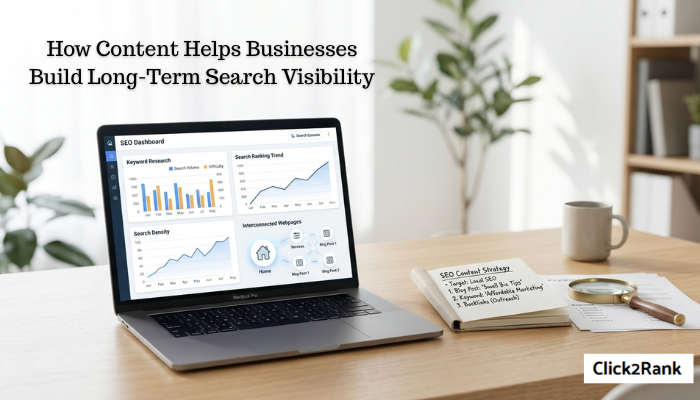
Content builds visibility by giving Google more opportunities to connect your business with relevant searches. Every relevant page creates another opportunity to appear in search results, and that reach grows as your content library expands. That’s the foundation of SEO content marketing: creating useful content that keeps working long after it’s published.
The challenge is that most businesses don’t see results from content right away. So our team at Click 2 Rank built this guide. You’ll learn what actually works, why some content strategies fail, and how to build search visibility that lasts.
Let’s start with how content creates that visibility.
How Content Creates Search Visibility
As we touched on above, content creates search visibility by giving search engines more pages to index and more signals to work with. The businesses that grow their organic search presence consistently are the ones that publish with both of those things in mind.

In practice, that means creating content that expands your search footprint while also strengthening the signals Google uses to understand your business. We break both down below.
Every New Page Creates Another Opportunity to Rank
Each page on your site creates another opportunity to appear in search results. Because search engines rank individual pages rather than entire websites, every page can target a different search query and attract its own traffic. As you add more relevant material, your site becomes eligible to appear in a broader range of searches.
That’s why businesses that publish content around their services, customer questions, and related topics create more opportunities to be discovered in search. Internal links strengthen that effect further by helping search engines understand how those pieces of content relate to one another.
Content Tells Google What Your Business Is About
Content also helps Google understand what your business does and which topics it should associate with your site. While a single service page provides some context, a site that covers related topics, common questions, and industry terms gives Google a much fuller picture.
For example, a personal injury law firm with articles covering accident claims and settlements gives Google strong signals about its expertise. In comparison, one with only a generic “Our Services” page provides far less context.
The same principle applies to any business: consistently publishing content around related topics helps build topical relevance over time. Google can then connect your site more confidently with searches that align with your expertise.
The result is broader search visibility as your content continues to build topical relevance.
Why Most Content Never Ranks
Most content never ranks because businesses write about what they want to say instead of what their audience is searching for.

For instance, a company might publish an article about why its service is the best option on the market. Meanwhile, their potential customers are typing “how do I fix this problem” into Google.
Those are two completely different conversations. Showing up to the wrong one means the article gets ignored, no matter how well it’s written.
That’s often where keyword research gets overlooked. Many businesses skip the step of identifying what people actually search for and write around internal talking points, marketing slogans, or industry jargon instead. The result is pages chasing phrases that almost nobody searches for, and organic traffic never follows.
What happens after publishing is just as damaging. A page goes live, gets shared once on social media, and never gets touched again. Without internal links pointing to it, search engines have little reason to treat it as an important page. Gradually, it drops in search rankings while stronger, fresher content takes its place.
Content Formats That Build Long-Term Search Visibility
Not every piece of content pulls the same weight in search. Some formats are built to rank once and fade, while others keep bringing in search traffic for years. Here’s what tends to hold up:
- Informational Blog Posts: These address the specific topics your target audience is searching for. Each article targets a different keyword, which means more entry points into your site from search. As that library grows, your website starts showing up for a wider range of searches.
- How-to Guides: People searching for step-by-step instructions are usually looking for a practical solution they can follow. A detailed guide answers that need directly, and it gives your site another opportunity to rank for relevant searches.
- Comparison Content: Some searches go beyond finding information. People may already be comparing options and deciding what best fits their needs. Comparison pages help them weigh the differences, understand the trade-offs, and choose the solution that fits their needs.
- Topic-Specific Landing Pages: Landing pages target commercial queries tied directly to a business’s core services. Unlike blog posts that build awareness over time, landing pages are built for visitors who already know what they want. Their job is to convert that intent into a call, a form submission, or a sale.
Together, these content types help businesses appear across a wider range of searches and stages of the customer journey. That’s what makes them such a valuable foundation for long-term SEO growth.
Creating a Sustainable Content Strategy
An effective content strategy starts with research. Before writing anything, find out what your audience is actually searching for.
If you’re not sure where to begin, start with long-tail keywords. These are more specific search terms, such as “local SEO strategy for small businesses” rather than simply “SEO strategy.” They usually face less competition and attract people with a clearer idea of what they’re looking for.
Next, look at which of those keywords are worth targeting. Use Google Search Console to see how existing terms are performing and prioritize keywords with medium difficulty. These are often easier to compete for than broad, highly competitive terms.
Once you’ve identified your target keywords, build content around them. It could be a blog post, guide, or comparison article. Whatever the format, every piece should address a genuine problem your readers are trying to solve.
Don’t stop after publishing a handful of articles, either. In almost every site audit we run, inconsistent publishing is the issue we flag most. Businesses that publish two focused articles a month consistently tend to outperform those that publish ten rushed posts and then go quiet.
How to Measure Whether Your Content Is Working
Publishing content is only half the job. The other half is checking whether it’s actually pulling its weight in search results. A few performance indicators make that easy to track:
- Organic Traffic Growth: This is the clearest sign your content is gaining traction. Use Google Analytics to track how many users are arriving at your site through organic search over time. A steady upward trend, even a gradual one, means your content is earning visibility in search results.
- Keyword Rankings: Track where your target pages are appearing in Google search results for the keywords you’re going after. Moving from position 15 to position 8 shows your content is gaining visibility and moving closer to the first page.
- Backlinks Earned: When other websites link to your content naturally, it’s a strong signal that you’ve published something worth referencing. As those links grow, they can strengthen your site’s authority and help improve search visibility.
- Time on Page: A page that holds visitors’ attention usually answers their questions effectively. Check this metric in Google Analytics and look for gradual improvements over time, especially on your most important pages.
None of these work in isolation. A page can attract traffic without ranking for the right keywords, or rank well without holding visitors’ attention. That’s why tracking all four together gives a far clearer picture than watching one metric alone.
Ready to Increase Organic Traffic That Lasts?
Search visibility isn’t built overnight, and it isn’t built by accident either. It comes from creating content that answers real questions, building a structure search engines can follow, and improving pages over time.
That’s the work we do at Click2Rank. Our content team builds strategies around keyword research, site structure, and measurable results.
If your business is ready to stop guessing and start building search traffic that compounds, get in touch. We’ll show you what a content strategy built for the long term looks like for your site.